Brain death, also called death by neurologic criteria, happens when a person has a severe brain injury that causes all brain function to stop forever. This includes the brainstem, which controls important functions like breathing and certain body reflexes.¹
Severe injuries, such as a stroke, head injury or lack of oxygen to the brain, can cause the brain to swell. This swelling can block blood flow to the brain and cause brain tissue to die. When all brain function is permanently lost, the person may meet the medical requirements for brain death.
Brain death is death. It is permanent and cannot be reversed. It is also legally recognized as death in the United States.¹
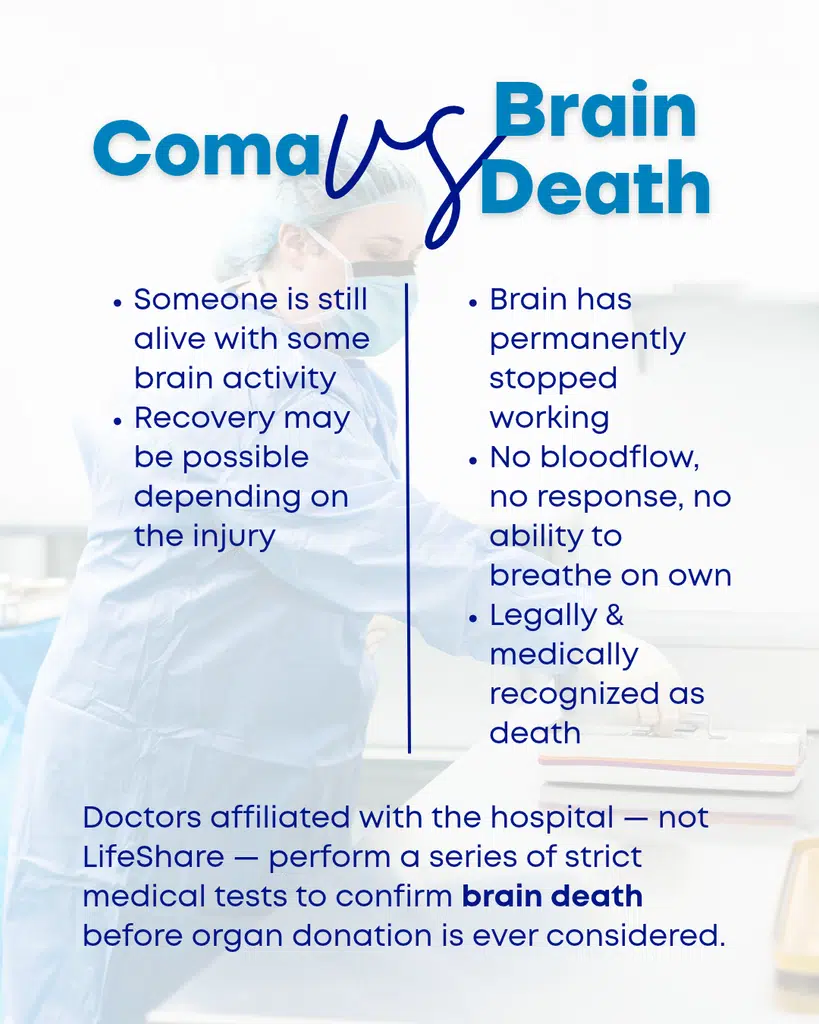
Brain death is different from a coma or other conditions that affect a person’s awareness. A person who is brain dead may look like they are sleeping, but their brain has permanently stopped working. They cannot wake up or breathe on their own.
What Is the Difference Between Brain Death and a Coma?
This is one of the most common questions families ask, especially when a loved one is connected to medical equipment.
A coma is a state of deep unconsciousness. A person in a coma is alive, and some brain function remains. Depending on the cause and how serious the injury is, the person may be able to recover. However, recovery is different for every patient.
Brain death is different. A person who has been declared brain dead has permanently lost all brain function, including brainstem function. There is no chance of the brain recovering.¹
These conditions are different, even though both may involve a person being unconscious and using a ventilator.¹
How Do Doctors Determine Brain Death?
Brain death is not declared after one simple test or because a patient has not responded to treatment. Doctors must complete a careful medical exam and follow approved medical guidelines.¹
The 2023 consensus guideline, created by the American Academy of Neurology, the American Academy of Pediatrics, the Child Neurology Society and the Society of Critical Care Medicine, explains how doctors determine brain death in adults and children.¹
Before starting the exam, doctors must confirm that the patient has a known, severe brain injury that could cause brain death. They must also rule out other conditions that could affect the results. These may include certain medicines, serious problems with the body’s chemical balance or a body temperature that is too low.¹
Once these steps are complete, the evaluation includes several important tests.
1. A neurological examination
The doctor checks how the patient responds to different tests and looks for signs of brain and brainstem activity. This includes checking whether the pupils respond to light, whether the eyes respond to certain movements and whether the patient has reflexes such as coughing or gagging.
In a person who meets the requirements for brain death, these brain-controlled responses are absent.¹
2. An apnea test
The doctor checks whether the patient can take a breath on their own when carbon dioxide levels rise to a set level. Carbon dioxide is a gas that normally tells the brain when it is time to breathe.
A person who meets the requirements for brain death will not try to breathe on their own during this test. The test is done while the medical team closely watches the patient and takes steps to keep them safe.¹
3. Additional testing, when needed
In some cases, the doctor may need more tests to help confirm brain death. Depending on the patient’s condition, this may include a test that checks blood flow to the brain.
The number and type of exams depend on the patient’s age and medical condition. Current brain death guidelines explain the testing requirements for adults and children.¹
Throughout this process, the medical team works to make sure the diagnosis is correct and that nothing else is affecting the test results.
What Happens After Brain Death Is Declared?
When brain death has been declared and organ donation is authorized, the donation process moves forward through the following steps. Learn more about the process of organ donation here.
How Does Brain Death Relate to Organ Donation?
Organ donation after brain death is one way a person’s gift can continue helping others.
Not everyone who dies can become an organ donor. However, when a person experiences brain death, medical support may help keep certain organs working well enough for transplant while the donation process takes place.²
The decision about brain death is separate from the decision about organ donation. Doctors use the same medical rules to determine brain death, whether or not a person has registered as a donor or their family agrees to donation.¹˒²
At LifeShare, donation coordinators work with hospital teams to guide families through the process, answer questions and offer support during a difficult time.
Frequently Asked Questions About Brain Death
Can Brain Death Be Reversed?
No. Brain death is permanent and cannot be reversed.¹
Before brain death is declared, healthcare workers do everything they can to treat the patient’s injury and save their life. If the brain injury is so severe that all brain function has permanently stopped and the patient meets the medical requirements, the person has died.
Sometimes, stories are shared about people who were said to be brain dead but later recovered. These cases may involve a coma or another condition that was incorrectly called brain death. A person who has been correctly declared brain dead cannot regain brain function.¹
Why Does the Heart Continue Beating After Brain Death?
Many people think of death as the moment the heart stops beating. This can make brain death hard to understand when a loved one’s heart is still beating after a doctor has declared them dead.
The heart has its own electrical system that allows it to beat without signals from the brain. When a patient is connected to a ventilator, the machine moves air into the lungs. This allows oxygen to enter the blood and reach the heart and other organs.
With this support, the heart may continue beating for some time even though the person has died.¹
However, a ventilator cannot restart brain function or reverse brain death. Without medical support, the heart and other organs will eventually stop working.
This is why a person who has been declared brain dead may still have a heartbeat, warm skin and a chest that rises and falls with the ventilator. These signs can be confusing and painful for families to see, but they do not mean the person is alive or getting better.¹˒²
Can a Person Move After Brain Death?
Families may sometimes notice twitching, muscle movements or other movements after brain death has been declared.
These movements can be upsetting to see, but are called spinal reflexes. The spinal cord can cause certain automatic movements without signals from the brain.
These movements do not mean the person is awake or that brain function has returned. Doctors know that spinal reflexes can happen when they check for brain death.¹
If a family sees a movement or has questions about what is happening, they should ask the medical team to explain it.
Why Is the Ventilator Kept on After Brain Death?
When a patient may be able to donate organs, the ventilator may stay in place after brain death is declared. It provides oxygen to the lungs and helps keep the organs working.
This support gives the donation team time to complete medical tests, work with transplant centers and plan for organ recovery when possible.
Keeping the ventilator on does not mean the patient is still alive or that doctors are trying to reverse brain death. A doctor has already declared the person dead. The medical support helps keep the organs in good condition for possible donation.²
Understanding Brain Death Can Help Families Find Clarity
Losing a loved one is never easy. Learning about the medical details surrounding their death can make an already painful time even harder.
Brain death is a medical and legal decision that a person has died. Machines may keep oxygen moving through the body and allow the heart to continue beating for a time, but they cannot bring back brain function that has permanently stopped.¹
When organ donation is possible, it gives a person’s legacy a chance to live on through others. This does not take away a family’s loss, but it may bring meaning during a heartbreaking time.
At LifeShare Network, we believe every family deserves kind support, clear answers and respect for their loved one’s wishes.
Learn more about organ, eye and tissue donation at LifeShareOK.org.
References
- Greer, D. M., Kirschen, M. P., Lewis, A., Gronseth, G. S., Rae-Grant, A., Ashwal, S., Babu, M. A., Bauer, D. F., Billinghurst, L., Corey, A., Partap, S., Rubin, M. A., Shutter, L., Takahashi, C., Tasker, R. C., Varelas, P. N., Wijdicks, E. F. M., Bennett, A., Wessels, S. R., & Halperin, J. J. (2023). Pediatric and adult brain death/death by neurologic criteria consensus guideline: Report of the AAN Guidelines Subcommittee, AAP, CNS, and SCCM. Neurology, 101(24), 1112–1132. https://doi.org/10.1212/WNL.0000000000207740
- Health Resources and Services Administration. (n.d.). Deceased donation. U.S. Department of Health and Human Services. https://www.hrsa.gov/optn/patients/organ-donation/deceased-donation